
This Guest Column appeared in Drug Store News | June 8, 2026 By Stephen Beckman, CEO.
Why supply reliability matters more than ever for pharmacies.
Reliable access to medicines has always mattered, but in today’s healthcare environment it has become a defining issue for pharmacy operations and patient care.
Drug shortages, supply disruptions, and backorders continue to challenge the healthcare system, forcing pharmacy teams to spend more time managing inventory gaps and less time focused on patients. What was once considered a behind-the-scenes function, supply chain performance, is now front and center.
Across the generics market, there is growing recognition that success can’t be measured by scale alone. Breadth of portfolio and speed to market still matter, but consistency—getting products to the shelf, on time, every time—is becoming just as critical.
From my perspective, it comes down to a simple reality: if a medicine isn’t on the shelf when a patient needs it, the system isn’t working as it should.
What’s often overlooked is just how complex that system really is. Supply chain is a sequence of interdependent stages, from sourcing active ingredients and components, to manufacturing, quality release, global transportation, distribution, and ultimately delivery to the pharmacy. Each step has to work, and work together.
The Operational Reality at the Pharmacy Counter
For pharmacists, supply reliability is a day-to-day operational reality.
Research published in the American Journal of Managed Care found that time spent managing drug shortages has more than doubled in recent years, rising from about 10.5 hours per week in 2019 to 24.2 hours per week in 2024. Across the U.S. healthcare system, that equates to millions of hours diverted away from patient care.
That time is spent tracking down product, managing backorders, communicating with prescribers, and identifying alternatives.
When supply is consistent, pharmacy operations become more stable. Inventory planning improves, administrative burden decreases, and patients are less likely to experience interruptions in therapy.
Reliable supply helps ensure patients aren’t caught in the middle.
Reliability Is Becoming the Differentiator
Generics account for more than 90% of prescriptions dispensed in the United States, making supply continuity essential to the entire healthcare system. Yet for years, the market has often prioritized expansion over execution.
That dynamic is shifting. On-time, in-full (OTIF) delivery, a key measure of how reliably manufacturers fulfill orders, is gaining importance as pharmacies and distributors look for partners they can depend on. But performance at that level isn’t just a goal, it’s often a requirement, with many agreements including service thresholds and penalties tied to delivery performance.
At the same time, manufacturers are balancing three constant pressures: price, continuity of supply, and service levels. Each influences the other, and imbalance in any one area can create downstream challenges.
Reliability should be part of how a business is built and how it operates every day, not something that is simply measured after the fact.
Why Partnerships Matter More Than Ever
No manufacturer operates in a vacuum. Reliable supply depends on coordination across manufacturers, logistics providers, distributors, and service organizations.
Today, much of the industry relies on specialized third-party logistics partners to manage warehousing, transportation, and distribution. These partners are essential to ensuring products move efficiently through the system.
Even strong manufacturing, regulatory, or commercial execution cannot deliver value if product does not reach its destination.
When these partnerships are aligned, the result is more predictable delivery, fewer disruptions, and better planning across the channel.
Building a More Resilient Supply Chain
Many disruptions in recent years stem from upstream challenges: manufacturing delays, quality issues, and logistical constraints. Some are predictable, others are not.
There are also broader market dynamics at play. As the generics market has expanded, the number of manufacturers supplying certain products has increased significantly, sometimes with more than a dozen suppliers for a single drug. While competition helps drive down costs, it can also create pressure that makes sustained production more challenging over time.
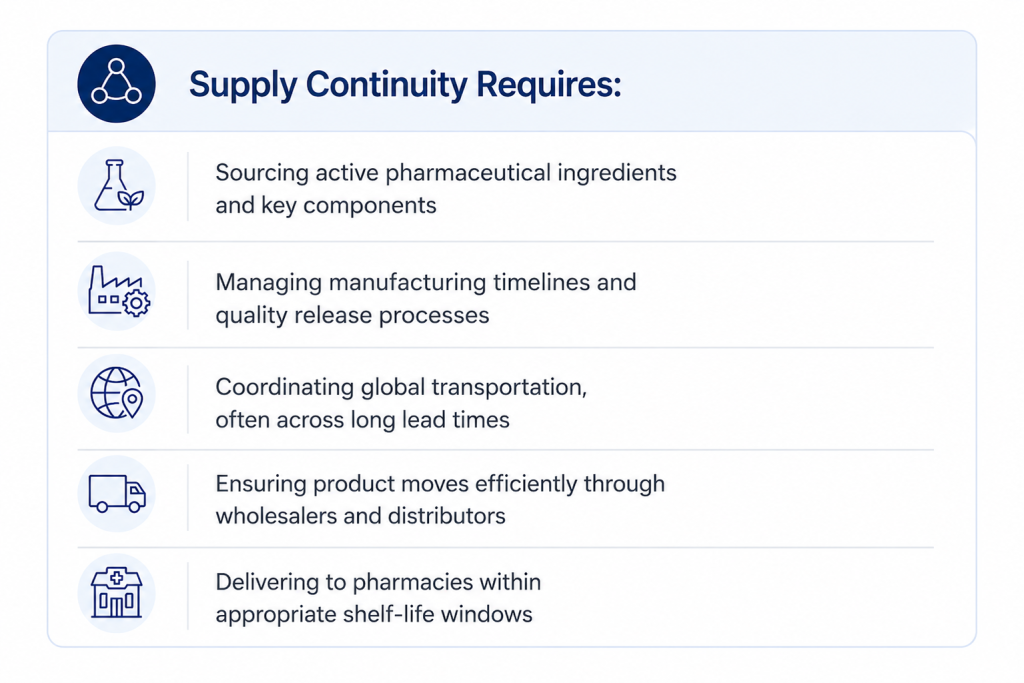
Each step introduces variables that must be actively managed. Delays in any one area, whether component availability, manufacturing timing, or transportation, can quickly impact downstream supply.
Maintaining reliability requires understanding how these parts connect and planning accordingly so product is available when needed and can reach patients without disruption.
Looking Ahead
As the generics market continues to evolve, reliability is no longer a “nice to have.” It is a core expectation.
Reliable access to essential medicines remains critical for pharmacies, providers, and patients, and that need continues to grow. For manufacturers, this means thinking differently about success, not just in terms of how many products are offered, but how consistently they are delivered.
Because in the end, access isn’t just about availability. It’s about consistency. And consistency is what keeps patients, and the healthcare system, moving forward.

AUTHOR INFORMATION
Stephen Beckman is CEO at YARAL Pharma. An industry veteran, he brings more than two decades of executive experience driving growth through strategic leadership, market insight, and a “Doing Things Differently” mindset. info@yaralpharma.com
Go to DNS to read the original article.
YPM-1643-EN-v1